

Here’s what you’ll learn in this guide:
- What exactly yeast is.
- How yeast works.
- The difference between instant, active, and fresh yeast.
- How to make yeast substitutions in any recipe.
- Where and how the dough should rise.
- A tip to make it rise faster!
- How to know when the dough has risen.
- Troubleshooting – what to do if the dough doesn’t rise!
These are all the questions I had when I first started baking so today I’m sharing all the answers with you so that you can start baking with confidence too!
Let’s get started!

Pictured: Italian Cheese Bread
What Exactly Is Yeast?
Baker’s yeast is called “Saccharomyces Cerevisiae” which simply means “sugar-eating fungus” (I know, not appetizing at all) but yeast is just that: a living organism with needs.
In fact, without sugar, warmth, and moisture, yeast cannot thrive which means your dough won’t rise. You need to provide all three for fluffy baked goods like these
How does yeast work?
So how does dough go from flat and heavy to puffy and airy anyway?
Basically, the yeast eats the sugar and releases carbon dioxide and alcohol in the process: the carbon dioxide is what makes your dough rise!

Pictured: Bavarian Cream Donuts.
There are 3 main types of yeast
- Instant dry yeast
- Active dry yeast
- Fresh yeast
What Is Instant Yeast?
Instant Yeast is the most commonly used yeast (that’s what I always use in all my recipes) because it doesn’t need to be activated so it’s quick, easy, and convenient!
It comes in granules, just like Active Dry Yeast, but has a finer texture and is the perfect type of yeast for beginners who are just starting to bake because it’s no-fail: you just add it to the bowl as if it were flour or sugar!
What Is Active Dry Yeast?
Active Dry Yeast also comes in granules but needs to be activated (or proofed) before being added to the rest of the ingredients. If you don’t activate it, the dough won’t rise.
How do you activate Active Dry Yeast
To a medium bowl, add 1/4 cup (60 ml) of lukewarm water or milk (about 110F or 43C), depending on the recipe, 1/4 teaspoon of sugar, and the Active Dry Yeast, give it a stir, and cover the bowl with plastic wrap to promote warmth and moisture.
Allow to sit for 10 minutes. After that, the mixture should be foamy and bubbly which means that you successfully activated the yeast!
You can now add it to the rest of the other ingredients, taking into consideration that you already used 1/4 cup of liquid for the yeast (so subtract 1/4 cup of liquid from the recipe you’re using).
If the yeast isn’t foamy, it’s not active so DO NOT add it to your dough as it won’t raise and you will waste the other ingredients! Simply discard it and check refer to the troubleshooting section down below before trying again!

Pictured: Pan De Coco (Coconut Bread).
What Is Fresh Yeast?
Fresh yeast comes in small light beige soft blocks with a pretty funny smell and, you guessed it, it’s fresh, meaning the yeast cells are fresh and active so it needs to be stored in the refrigerator and used within a week.
This type of yeast isn’t very popular in the US nowadays but it’s what a lot of professional bakers use. In other countries, it’s still widely used and preferred as it makes the dough rise faster and yields even softer baked goods.
Growing up in Italy, my mom used this all the time and always kept two cakes in the fridge for last-minute pizza nights or treats and, I’m telling you, if you can, fresh yeast is best!
The reason why I always use instant in my recipes is because I know it’s preferred in the US and it’s also easier and quicker for beginners to use and I always strive to make my recipes approachable.

Can I Substitute Instant Yeast for Active Dry Yeast?
Yes! To substitute Instant Yeast for Active Dry, use 25% less.
Can I Substitute Active Dry Yeast for Fresh Yeast?
Yes! To substitute Active Dry for Fresh Yeast, use 50% less.
Where Should The Dough Rise?
Ideally, in a warm (72-77F or 22-25C) and peaceful environment which means you shouldn’t touch the bowl where the dough is rising, so if you have pets or kids, make sure they won’t get to the bowl!
How should the dough rise?
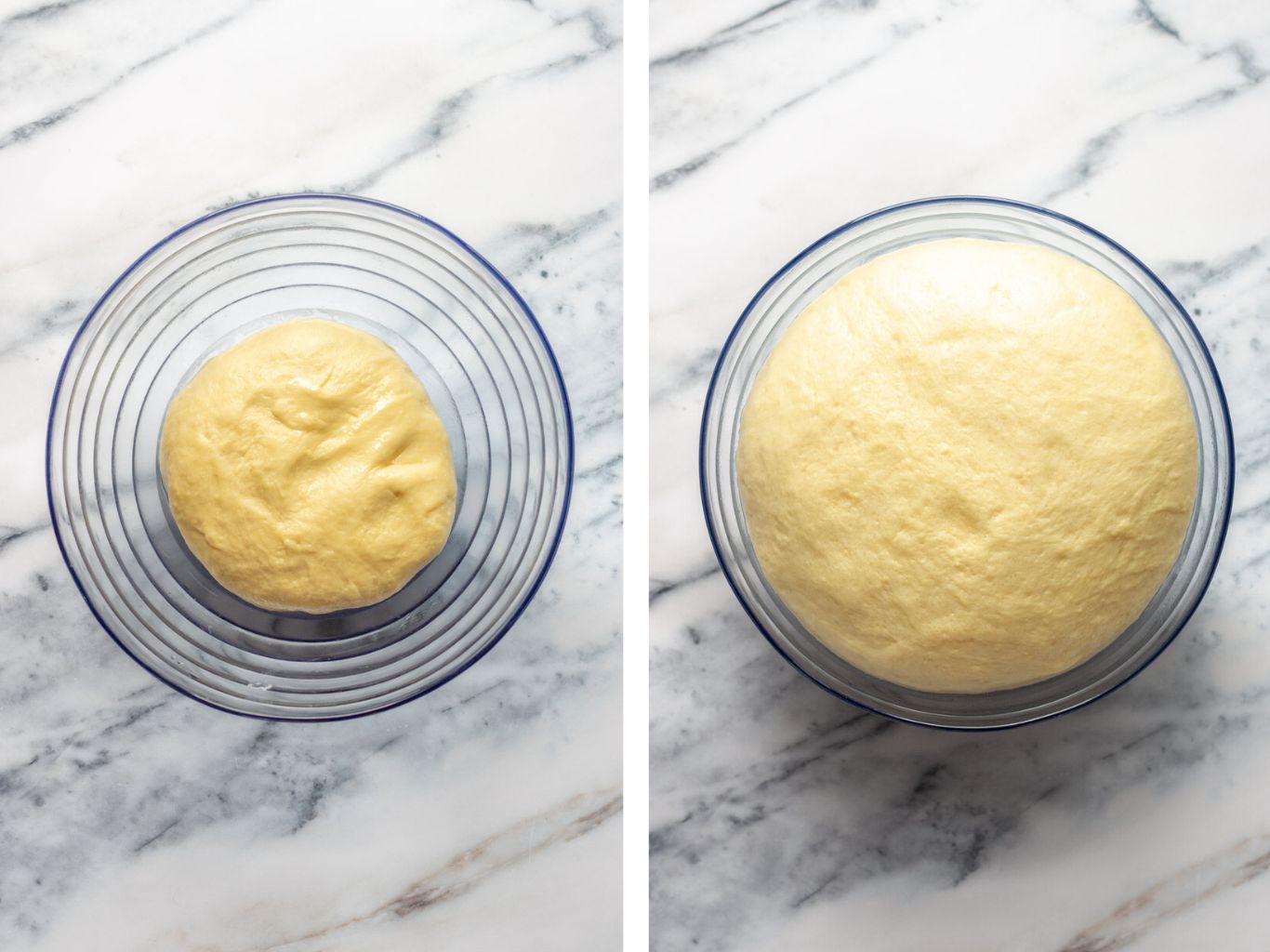
What you do is grease a large bowl with vegetable oil, form the kneaded dough into a ball (knead until smooth and elastic), place it into the bowl, brush it with oil, and cover the bowl with plastic wrap to promote warmth and moisture.
The dough should double in size. Most recipes typically call for two rises which means that you’ll make the dough rise for 60-90 minutes or until doubled in size and then again for just 30-60 minutes after shaping, stuffing, or whatever the recipe you’re using calls for (basically, when it’s ready to be baked).

Pictured: Authentic Italian Stromboli.
How Do You Make Dough Rise Faster?
Preheat the oven to 110F (43C), then turn it off and place the covered bowl inside the oven, close the oven door and let it rise. Check after 40-60 minutes.
Because this method involves a higher temperature, make sure to check the dough from time to time so you know it’s not over-proofing (yes, it’s possible!).
How Do I Know If My Dough Has Risen?
It’s super simple: your dough should be doubled in size! You can also test it by poking it with a finger: if the indent springs back slowly or doesn’t quite spring back, it’s ready!

Pictured: Pumpkin Bagels.
Troubleshooting! My Dough Isn’t Rising! What Do I Do?
🌡 The water/milk wasn’t too cold or too hot. The liquid you’re using should always be around 110F (43C). Cold water won’t activate the yeast while hot water will burn it. Discard and start over (sorry!).
🍭 You didn’t add any sugar. Yeast needs sugar to thrive so if you didn’t feed it, it won’t activate. Discard and start over (sorry!).
🥄 You added too much flour. If you added a lot more flour than what the original recipe called for, the yeast might just not work. A packet of dry yeast (usually 2 and 1/4 teaspoon or 7 g) will rise up to 4 cups (500 g) of flour so don’t overwhelm your yeast with more!
⚡️ You used Active Dry Yeast without activating it first. Oops! Discard it, check the “How Do You Activate Active Dry Yeast” section above and start over (sorry!).
❄️ It’s too cold! If you did everything right, it might just be really freakin cold! Place the dough in a warmer environment or use my “How Do You Make My Dough Rise Faster” tip (scroll up)!
❌ The yeast was expired or poorly stored. Unopened dry yeast (active or instant) has a shelf life of 12 months but if the package stuck around opened for a few months, it might just not work anymore. Fresh yeast, on the other hand, should always be kept in the refrigerator and used within a week.
If you know the yeast was old or stored poorly and the dough didn’t rise, you should discard it and start over (sorry!).

Pictured: Pan De Coco (Coconut Bread).
Yay! I Got It! What Can I Make Now?
YAY!!!! You can successfully bake anything that contains yeast, from donuts to pizza! Here are a few recommendations:
- Italian Cheese Bread – stuffed with cheese and olives with lots of add-in ideas!
- Bavarian Cream Donuts – there are better than Dunkin’, you need to try them!!!
- Authentic Italian Stromboli – with lots of salami and cheese, just delicious!
- Pan De Coco (Coconut Bread) – crispy caramelized coconut tops and fluffy centers!
- Pumpkin Bagels – the perfect fall treat!
If you have any questions or doubts, please comment down below, I’ll check in no time!


Leave a Reply